
Shared Hosting vs VPS Hosting in Pakistan: Which Should You Choose?
Not sure whether your website needs shared hosting or a VPS? Compare resources, management responsibilities and upgrade signals before deciding.
Your website may look simple while its hosting needs tell a different story. A company profile, online shop and custom application place different demands on a server. Understanding shared hosting vs VPS hosting in Pakistan helps you choose suitable resources without unnecessary complexity. Shared hosting can keep everyday website management straightforward. A VPS offers greater control when your application needs a different environment. However, choosing the bigger option doesn’t automatically solve slow pages or unreliable software. This guide explains the differences in server resources, website performance and technical support. You’ll also learn how to recognise upgrade signals and prepare a safer move as your business grows across Pakistan over time.
Shared Hosting vs VPS Hosting in Pakistan: Key Differences
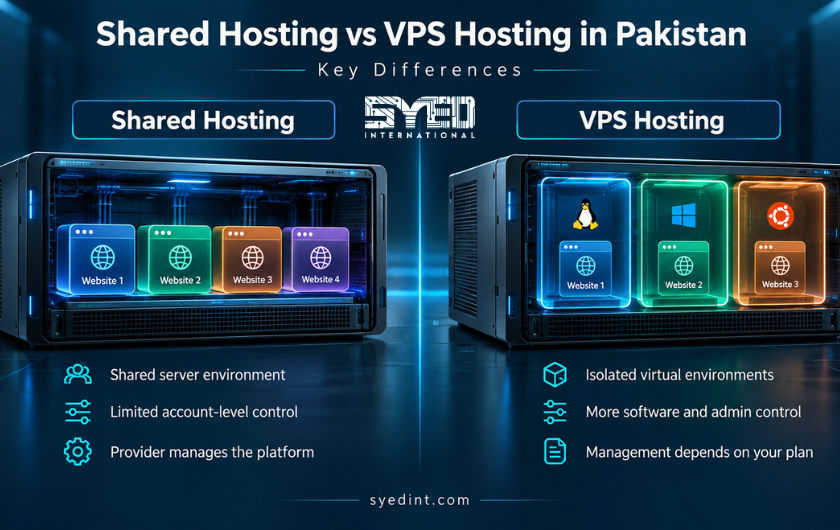
Shared hosting gives your website an account within a server environment used by other customers. The provider usually manages the server software and offers tools for everyday account tasks. You work within the permissions and limits attached to your account. These may cover storage, databases, email, memory and simultaneous processes. For a small consultancy website, this arrangement can be straightforward to manage. You can publish service pages and receive enquiries without administering an entire operating system. However, shared hosting doesn’t mean every account receives unlimited access to the machine. Ask your provider which limits apply and where you can view actual usage. Compare those details with your website’s workload rather than choosing by storage alone. Think about a Karachi design studio with a portfolio and contact form. Its immediate concern might be reliable email and simple maintenance rather than advanced server customisation. Syed International’s shared hosting services describe account features for this type of setup. Check your own website requirements before deciding whether those features provide enough room for daily operations.
A virtual private server gives you a separate virtual environment within physical infrastructure. Virtualisation divides hardware into environments that can run their own operating systems. IBM’s virtual private server guide explains this distinction between virtual servers and ordinary shared accounts. Depending on the service, VPS hosting can offer administrative access and more freedom to install supported software. However, the word private doesn’t mean you receive an entire physical machine. Also check whether CPU capacity is shared, reserved or subject to usage conditions. Memory allocation, storage performance and network limits deserve separate attention. Next, clarify who manages the environment after setup. With an unmanaged VPS, your team normally handles operating system maintenance and application configuration. A managed VPS includes assistance within an agreed scope rather than an automatic promise to fix everything. Ask specifically about updates, monitoring, backups and incident response. When comparing shared hosting vs VPS hosting in Pakistan, these responsibilities matter alongside the resource figures. More control is useful only when somebody can manage it properly.
| Feature | Shared hosting | VPS hosting |
|---|---|---|
| Environment | Account within a provider-managed setup | Separate virtual server environment |
| Administrative access | Usually limited to account tools | Often available, depending on the service |
| Software choices | Restricted to supported applications | Greater flexibility within technical limits |
| Resources | Account limits within shared infrastructure | Allocated resources with plan-specific CPU policies |
| Server maintenance | Provider usually manages the platform | Responsibility depends on management scope |
| Good starting point | Straightforward websites with suitable limits | Applications needing extra control or capacity |
Choosing Hosting for Your Website
Actual workload tells you more than a monthly visitor total. Two websites can attract similar traffic while using very different resources. A cached information page may need little processing after its first request. By contrast, customer dashboards and shopping carts often need fresh database responses. Review your resource usage during busy periods rather than guessing from the number of pages. Ask whether slow requests coincide with memory limits, overloaded processes or application errors. Before upgrading, examine the website itself. WordPress performance guidance covers practical improvements such as caching and reviewing performance bottlenecks. Large images and inefficient plugins can remain troublesome after a server move. A VPS cannot repair broken application logic by itself. For example, imagine a clothing store launching a promotional campaign across Pakistan. Its product pages may load quickly while checkout slows during busy periods. That situation needs investigation into checkout requests, database activity and available capacity. Test the complete customer journey rather than judging only the homepage. Shared hosting vs VPS hosting in Pakistan becomes a more useful comparison when you have this evidence. A suitable shared account may still work after optimisation. Alternatively, repeated resource limits may justify a properly configured VPS.
Your application requirements should shape the final decision. A brochure website and a custom business portal rarely need identical environments. If your developer needs background workers or special packages, confirm support before choosing hosting. Some shared environments support Node.js while others restrict it or offer limited process control. Ask about the specific runtime version, deployment method and restart behaviour. Syed International’s Linux VPS options provide another route for reviewing Linux-based infrastructure. Meanwhile, Windows VPS options may suit software that specifically requires a supported Windows environment. Choose according to application compatibility and administration needs rather than assuming either operating system guarantees better search rankings. For businesses serving customers nationwide, check server region and network performance too. A Pakistani hosting company may use infrastructure outside Pakistan. Test important pages from the locations where your customers browse. Then discuss technical support in practical terms. Who investigates downtime, restores backups and handles security updates? Make sure your team understands the answers before moving. Consider another example: a small services company whose website runs smoothly within its current limits. It may gain little from taking on server administration immediately. A growing portal with unsupported software requirements faces a different decision. The better choice follows the workload and available expertise.
Shared Hosting vs VPS Hosting in Pakistan: Planning Your Move
A successful upgrade needs a migration plan before any DNS changes. Record your domains, databases, mailboxes and scheduled tasks first. Download an independent backup and confirm that it includes the files you actually need. Agree on how new orders or form submissions will transfer during the switch. Test the destination using a supported preview method without changing the live website prematurely. Check login, forms, checkout, email delivery and HTTPS. WordPress migration guidance explains additional steps for moving WordPress installations between servers. If only the hosting server changes, you don’t necessarily need to change your domain name. Keep existing email records intact unless email is moving too. Cached DNS records can temporarily direct some visitors to the previous server. Allow for that overlap before closing the old account. Finally, confirm backups and monitoring work in the new environment. Shared hosting vs VPS hosting in Pakistan should end with a practical choice you can maintain. If you need help reviewing your workload, contact Syed International with your website details and current limitations.